DeWalt DCL040 vs DCL043: Which Work Light? (November 2026)
Choose the DeWalt DCL040 for small, nearby tasks, the DCL043 for a high-output spotlight, or the DCL050 for frequent hanging and repositioning. Match the light to the area you need to see and the supports near your work.
On this page (9 sections)
- DeWalt DCL040 vs DCL043: which is brighter?
- How do their heads and hooks affect placement?
- Which light suits your regular jobs?
- Is the DCL050 a better middle ground?
- What should you plan for batteries and runtime?
- How should you set up a cordless work light?
- Which buying mistakes are easiest to avoid?
- How do you care for the light between jobs?
- Should you buy the DeWalt DCL040 or an alternative?
The DeWalt DCL040 suits small, nearby repairs, while the DCL043 suits buyers who need a high-output spotlight. Choose the DCL050 instead when hanging the light and changing its aim are central to your work.
Think about the patch you need to see, not just which model has the bigger number. Reading a label inside a cabinet, checking a dark corner across a shop and lighting a repair with both hands occupied call for different setups.
A cordless work light should put light where your room fixtures can't reach. These models make the most sense when you choose around that specific gap.


DeWalt DCL040 vs DCL043: which is brighter?
The DCL043 produces 1,500 lumens at maximum output, compared with the DCL040's 110 lumens. That makes the spotlight the stronger choice for directing more light beyond a small, nearby work area.
The difference is more than 13 times in total output, but it doesn't mean every surface will look 13 times brighter. Distance, beam shape, surface color and the angle of the light all affect what you can see.
The DCL043 has 2 brightness settings, giving you a choice between maximum output and longer runtime. DeWalt also says it can be seen up to 508 yards, which describes visibility rather than a useful repair distance.
Buy it for checking a specific spot across a dark space or directing light toward an area you can't approach easily. Don't plan a detailed task hundreds of yards away around that visibility figure.
The DCL040 fits work where you can bring the light close to the detail. A cabinet hinge, a label behind stored items or a small repair beside a bench is a more sensible target than an entire garage bay.
If your whole garage feels dim, improve the room lighting first. Our garage lighting guide explains how fixed lights and portable task lights serve different parts of the same workspace.
How do their heads and hooks affect placement?
The DCL040 offers more head movement, while the DCL043 offers more placement choices. Choose around the support you actually have near your work.
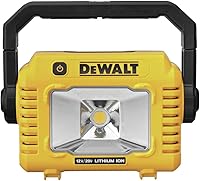
The DCL040 has a 120-degree rotating head and an integral hook. The DCL043 has a 90-degree pivoting head, an integral hook and a belt hook, and can project light in different directions while standing on its base.
Head movement describes how far you can adjust the head, not how wide an area the beam covers. Don't read those angles as a measure of flood coverage.
A hook is most useful when it puts the light beside or above the task without letting it swing into your tools. Check the support's shape and strength, then make sure the beam reaches the work without your body blocking it.
When does the DeWalt DCL040's head movement help?
The DCL040's adjustable head helps when the support point stays fixed but your target changes. You can alter the aim without moving the whole light each time.
For example, a repair inside a cabinet may require light on the hinge first and the rear mounting point next. Choose a hanging position that leaves room for that adjustment before you start taking parts out.
A wider movement range won't solve a blocked beam. If a shelf lip or your forearm cuts off the light, move the light to another side of the work.
When does the DCL043's base help?
The DCL043's base helps when you have a stable surface but no useful hanging point. Set it where the head can aim toward the target without occupying your working space.
A nearby shelf or clear bench area can be more useful than a hook directly over your hands. Keep the light away from the bench edge and check that changing the head angle doesn't leave the setup easy to knock over.
Which light suits your regular jobs?
Choose the DCL040 for close detail, the DCL043 for spotlight work, or the DCL050 for suspended task lighting. Your most frequent job should decide the purchase.
Choose the DCL040 for small repair areas
The DCL040 suits someone who needs extra light on one small part of a larger workspace. It makes sense when you can position it near a fitting, fastener or label rather than lighting the task from across the room.
Skip it if your main complaint is that large areas remain dark. Its modest output gives you less room to work around distance or a poor placement spot.
It also makes less sense if you regularly need selectable brightness. The other 2 models explicitly offer high and low settings.
Choose the DCL043 for a directed spotlight
The DCL043 suits buyers who move between nearby work and checks farther across a dark space. Its higher output makes it the clear choice here when directing a strong light at a particular target matters most.
Skip it if your only task is a close repair on a reflective surface. More light can create distracting reflections when the source sits at the wrong angle, so placement still comes before maximum output.
Our DeWalt DCL043 review looks more closely at that model. For a broader choice of formats, compare our best rechargeable work lights.
Choose the DCL050 for repeated repositioning
The DCL050 suits jobs where the light needs to stay suspended while you change its direction. Its hook is the main reason to choose it over the simpler DCL040 or spotlight-style DCL043.
Skip it if you mostly carry a light while scanning distant spots. Its distinctive advantage is how you can hang and aim it near work.
Is the DCL050 a better middle ground?
The DCL050 is a placement-focused alternative, rather than an automatic halfway point between the other lights. Buy it because its hanging arrangement solves your setup problem.
Its telescoping hook rotates 360 degrees and can hang from 2-inch materials. That gives you a way to orient the body after hanging it, while the head's 140-degree pivot adds a separate aiming adjustment.
Those features matter when the available support isn't lined up with the repair. Think of a job where the secure hanging point sits off to one side and you need the light facing inward.
Confirm the high and low lumen values for the exact DCL050 version before choosing by brightness, since published figures differ. If output alone drives the decision, settle that detail before ordering.
The DCL050's belt hook is an optional accessory, unlike its built-in hanging hook. Don't count on having that extra carrying option in the box.
What should you plan for batteries and runtime?
Plan a working battery and charging setup, not just a bare light. All 3 models come without batteries, and the DCL040 and DCL050 also come without chargers.
If you already use DeWalt cordless tools, check exact compatibility before assuming any battery you own will fit. If you're starting fresh, include the light, compatible battery and suitable charger in your decision.
DeWalt gives the DCL040 a runtime range of 11–25 hours depending on battery amp hour. That range belongs to this model and shouldn't be used to predict either alternative's runtime.
Battery capacity can help with longer sessions, but it also affects the complete setup you carry or hang. Choose around the length of your typical job and the position where the light will spend most of its time.
For occasional repairs, keeping a suitable battery charged may matter more than chasing the longest possible session. For extended work, plan when you can recharge and whether another compatible battery needs to be ready.
Don't routinely borrow the only charged battery from a tool you need for the same job. Our guide to choosing a rechargeable work light explains how power needs and placement fit together.
How should you set up a cordless work light?
Start by placing the light beside the task and outside your working path. Adjust the beam before picking up the tool you'll use for the repair.
- Clear a stable surface or choose a secure hanging point near the work.
- Install a charged, compatible battery according to the light's instructions.
- Aim the head at the detail you need to see.
- Put your hands in their working position and check for shadows.
- Reposition the light if reflections hide edges or markings.
For a cabinet repair, try lighting from the side opposite your main working hand. This reduces the chance that your wrist will block the beam each time you reach for the fastener.
For shiny metal, move the light off the direct viewing line if the reflection hides detail. Changing the angle is often more useful than simply switching to a brighter setting.
When checking a distant area, pause in a stable position before aiming. Keep the beam out of other people's eyes, and lower or redirect it before turning toward someone nearby.
If no secure support gives you the angle you need, consider a different format. Our work lights with stands guide covers options that bring their own support.
Which buying mistakes are easiest to avoid?
The biggest mistake is buying for maximum output without planning placement. A brighter light in the wrong spot can leave the exact repair area behind a shadow.
Don't assume a handheld spotlight will spread useful light across every wall and corner. For a whole-room problem, solve the room's coverage rather than adding another portable light to the same poorly lit bench.
Avoid choosing solely by the head angle, too. Sketch where the light can sit or hang, then work out whether the head can face the target from there.
Don't mistake a built-in hook for permission to hang the light anywhere. A rounded edge, moving part or weak support can make the setup unstable even when the hook appears to fit.
Missing kit parts are another avoidable problem. Before ordering, check the included components once, especially if you don't already have a battery system and charger ready.
Finally, separate frequent needs from rare ones. A light that solves your weekly repair job is usually a better choice than one chosen around a distant task you might attempt once.
How do you care for the light between jobs?
Keep the lens, battery connection and moving parts clean, and store the light where it won't be knocked around. Follow the model's instructions for cleaning and storage.
Remove the battery before cleaning or inspecting the light. Use a soft cloth for the lens, and avoid rough materials that could scratch the surface and scatter light.
Brush away loose debris around the battery connection without forcing dirt farther inside. If you see damaged contacts, a cracked case or a hook that no longer holds securely, stop using that setup until the issue is addressed.
The DCL043 and DCL050 have over-molded lens covers that DeWalt describes as non-marring. Wipe grit off before resting either against a finished surface, since trapped debris can still scratch.
Don't force the head beyond its travel or use the hook as a handle for unrelated loads. Put the light away with its lens protected from loose screws, drill bits and other hard tools.
No water-protection details are established here, so choose a dry position and follow each model's moisture precautions. Don't assume a jobsite light is suitable for rain or washing down.
Should you buy the DeWalt DCL040 or an alternative?
Buy the DeWalt DCL040 if you can bring the light close to a small task and don't need selectable brightness. Before ordering, identify the exact place you'll hang it and the detail it needs to illuminate.
Choose the DCL043 when your regular work calls for a directed spotlight beyond that close repair area. Choose the DCL050 when suspended placement and repeated aiming adjustments will make the job easier.
If you still can't identify a secure, useful position for any of them, compare other formats in the work lights category. The right support and beam direction should be part of the buying decision from the start.
Frequently asked questions
Is the DeWalt DCL043 brighter than the DCL040?
Yes. The DCL043 reaches 1,500 lumens, while the DCL040 produces 110 lumens, making the DCL043 the choice when output is the priority.
For a nearby repair, consider where the light will sit: a well-placed light can reveal details that remain in shadow under a brighter light aimed from the wrong direction.
Which DeWalt light has the wider pivot?
The DCL050 has the widest head movement here, followed by the DCL040 and then the DCL043. Their movement ranges are 140, 120 and 90 degrees, respectively.
Choose around your intended support point, since a larger movement range only helps if you can position the light where it needs to go.
Do the DCL040 and DCL043 include batteries?
Neither includes a battery, and the DCL040 also requires a separately sold charger. Before ordering, check the exact battery and charging requirements against the equipment you already have.
If this is your first cordless light, plan the complete setup so you can use it when it arrives.
Can you hang the DCL043?
Yes. The DCL043 has an integral hook and a belt hook for hands-free placement, and it can also stand on its base.
Use a secure support and aim the head before starting work; keep the light outside your arm movement so a dropped tool or shifting elbow won't knock it loose.
Is the DCL050 a better middle option?
The DCL050 is the better choice when hanging flexibility drives the decision. Its telescoping hook rotates through a full circle, while the head offers more movement than either comparison model.
Choose it for that setup advantage, and confirm the exact version's brightness values if output is central to your purchase.