How Many Shop Lights Do You Need for a Garage?
Calculate how many shop lights you need by dividing your garage's target total lumens by lumens per fixture, then round up. Use that count to plan evenly spaced rows, with extra task lighting where vehicles, shelves, or your body cast shadows.
On this page (8 sections)
- How many shop lights do you need for your garage size?
- How do you calculate a starting light count?
- Do ceiling height and room layout change the count?
- Should you use 4 ft or 8 ft shop lights?
- How should you space shop lights for even coverage?
- Do you need extra light over a workbench?
- What setup and care checks matter most?
- How many shop lights should you buy?
Calculate how many shop lights you need by dividing your garage's target total lumens by lumens per fixture, then round up. For a 20 x 20 ft garage, a planning range of 50 to 75 lumens per square foot gives about 5 to 7 lights producing 4,400 lumens each.
That count is the starting point. Before buying, place the fixtures on a sketch of your garage so vehicles, shelves, and your own shadow won't leave the work areas dim.
How many shop lights do you need for your garage size?
Use floor area and fixture output to estimate the count, then check coverage. The table below uses 50 to 75 lumens per square foot as a practical planning range for general garage use and workshop activity.
| Garage dimensions | Floor area | Target total lumens | Lights at 4,400 lumens each | Lights at 10,000 lumens each |
|---|---|---|---|---|
| 12 x 20 ft | 240 sq ft | 12,000–18,000 | 3–5 | 2 |
| 20 x 20 ft | 400 sq ft | 20,000–30,000 | 5–7 | 2–3 |
| 24 x 24 ft | 576 sq ft | 28,800–43,200 | 7–10 | 3–5 |
These are estimates based on light leaving the fixtures, not measurements of light reaching a workbench. Dark walls, tall ceilings, and blocked light paths can call for a different layout or more focused lighting.
Use the lower end for parking, storage, and basic movement. For regular repair or craft work, consider the upper end plus task lighting; our guide to how many lumens you need in a garage helps you choose a target.
How do you calculate a starting light count?
Calculate length × width × target lumens per square foot ÷ lumens per fixture. Round up only after completing the calculation.
- Measure the garage's length and width in feet.
- Multiply them to find the floor area.
- Choose a brightness target for your main use.
- Multiply area by that target to find total lumens.
- Divide by one fixture's output and round up.
How many shop lights do I need if the result falls between counts?
Round up to a whole fixture, then decide where that extra light will help. A 400-square-foot garage at 60 lumens per square foot needs 24,000 lumens; dividing by 4,400 gives 5.45, so start with 6 lights.
If the count leaves a dark bench, give that area its own light. Raising brightness across the entire garage is often less useful than placing one fixture where you handle small parts.
The Hykolity single fixture suits buyers adding lights gradually or filling a gap above a bench. Its 42W draw, cord switch, and 59-inch power cord make outlet location part of the plan.
It supports up to 6 linked fixtures and includes chains and screws for hanging or flush mounting. Choose it for flexible placement; skip it if you need long, high-output ceiling runs with fewer separate fixtures.
Its open-frame design has no plastic cover. Keep it out of reach of stored boards and other items that could strike it.
Do ceiling height and room layout change the count?
Yes, mounting height and obstacles change the light that reaches your work. Don't apply a fixed extra-light percentage for a tall ceiling without considering the fixture's beam pattern and intended mounting height.
Mark door tracks, openers, beams, and ceiling storage on your sketch. Include the garage door in both its open and closed positions, since a raised door can block light from fixtures above it.
Dark wall and ceiling finishes reflect less light than pale ones. In a cluttered garage, moving a fixture to a clear position may help more than adding another beside an existing light.
For a high ceiling, compare high-bay and low-bay lights before buying extra shop lights. A fixture suited to the mounting height can be a better choice than increasing the count of a poorly placed model.
The Barrina 10-pack suits a large garage or shop with long, clear ceiling runs. Each fixture draws 72W, measures 94 inches long, and links with up to 4 fixtures per run.
Choose it when fewer high-output units fit your layout. Skip the pack for a small bench upgrade or a ceiling broken up by storage and door hardware, where shorter lights offer more mounting choices.
When expanding an older Barrina setup, check connector compatibility. Barrina specifies the newer male-female connector cables when joining its new and older versions.
Should you use 4 ft or 8 ft shop lights?
Choose 4 ft fixtures for flexible placement and 8 ft fixtures for long, clear runs. Length alone doesn't determine the right count; compare usable mounting positions and lumen output together.
Shorter lights let you divide the ceiling into smaller zones. That helps when one side holds a vehicle and the other has shelves, a bench, or a separate work area.
Longer fixtures reduce the number of individual mounting locations when their output fits the target. Measure the full mounting space before ordering, including room to install connectors and route cords.
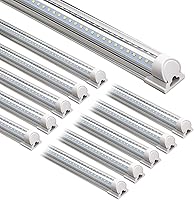
The Sunco 10-pack suits buyers planning several shorter rows or lighting more than one indoor work area. It includes mounting hardware and hanging chains, so you can choose flush or suspended placement.
Sunco gives conflicting output figures of 4,100 and 4,500 lumens. Use the lower figure for a conservative count; a 24,000-lumen target would need 6 fixtures.
Skip the pack if your plan needs only one or two additions. Also map separate power feeds before buying, since the whole pack cannot form one linked run.
For more help matching fixture style to your space, see how to choose LED shop lights for a garage.
How should you space shop lights for even coverage?
Place lights in rows that cover the areas you use, rather than bunching them along the center. Follow the manufacturer's spacing guidance and check the light at working height.
In a two-car garage, two rows can put light closer to both vehicle bays and side work areas. Leave coverage near the walls instead of using every fixture above the parking aisle.
Park vehicles in their normal positions when checking the layout. Look inside open drawers, along shelf fronts, and beside the vehicle, where overhead light may be blocked.
Don't assume connecting fixtures end to end creates the best spacing. Linking simplifies power connections, but the layout still needs to suit the room.
Use our shop light spacing guide to plan rows and our hanging guide to choose mounting positions.
Do you need extra light over a workbench?
Add dedicated bench lighting when ceiling fixtures leave your hands or tools in shadow. Position it above or slightly in front of the work surface so your body doesn't block the light.
Check the view from your normal working position. A bare light source directly in your sightline can cause glare, especially around shiny metal parts.
A shorter fixture can serve a bench without lighting the whole garage. For work that moves around a vehicle, a work light with a stand gives you more aiming options.
Keep color temperature separate from brightness: a whiter-looking light doesn't automatically deliver more lumens. See the best color temperature for garage lighting if you're also choosing the light's appearance.
What setup and care checks matter most?
Check mounting supports, connection limits, and circuit load before installation. Follow the exact fixture instructions, and use a qualified electrician for new wiring.
Count the electrical draw of the lights and any tools sharing the circuit. A permitted linked run doesn't mean the entire circuit has enough capacity for every load.
Secure cords away from moving door hardware, sharp edges, and places where stored items can snag them. Support each fixture properly rather than letting connectors carry its weight.
For wiring details, read how to wire and link LED shop lights safely. Plan separate feeds where the fixture connection limit requires them.
Switch off power before cleaning and let fixtures cool. Remove dust with a dry, soft cloth according to the care instructions, and avoid spraying cleaner into LEDs, switches, or connectors.
Check chains, fasteners, and cords during routine garage cleanup. If a fixture becomes loose or a connection shows damage, stop using it until the problem is corrected.
How many shop lights should you buy?
Buy the count that meets your lumen target and layout, then add task lighting only where needed. When deciding how many shop lights you need, draw the rows before choosing a pack size.
Choose Hykolity for a single addition or a layout built in stages. Choose Sunco for several shorter rows, or Barrina when long ceiling runs suit fewer high-output fixtures.
Avoid buying a 10-pack simply because the room is a garage. Match the quantity to measured space, planned mounting points, and safe power connections.
For help bringing the whole plan together, use our complete garage and workshop lighting guide.
Frequently asked questions
How many shop lights do I need for a 2-car garage?
A 20 x 20 ft garage needs about 5 to 7 fixtures producing 4,400 lumens each when using a planning range of 50 to 75 lumens per square foot. With 10,000-lumen fixtures, the starting count is 2 to 3; check coverage around vehicles and add bench lighting where needed.
How far apart should shop lights be?
Space shop lights according to their light spread, mounting height, and the work areas below them. Begin with the manufacturer's guidance and lay out evenly spaced rows, then check for gaps along walls and between vehicles; a fixed spacing rule can leave shadows when fixtures have different beam patterns.
Are 4 ft or 8 ft shop lights better for a garage?
Choose 4 ft shop lights for flexible placement around tracks, shelves, and benches, or 8 ft lights for long, clear ceiling runs. Compare lumens as well as length; several smaller fixtures offer more placement points, while fewer larger fixtures can simplify a layout when their light reaches the right areas.
Can I connect several linkable shop lights together?
Yes, within each model's connection limit: these Sunco and Barrina lights allow up to 4 fixtures per linked run, while Hykolity allows up to 6. Use compatible connectors and follow the electrical instructions; split larger layouts into separate runs, and check the circuit load from lights and tools together.