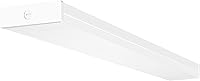
How to Choose LED Shop Lights for a Garage
Choose LED shop lights for a garage by matching light output, fixture placement and power connections to your work areas. Use flexible 4 ft fixtures around separate zones or longer 8 ft fixtures where you have clear ceiling runs.
On this page (12 sections)
- What should you check before choosing LED shop lights for a garage?
- How bright should a garage shop light be?
- Should you choose 4 ft or 8 ft fixtures?
- Does color temperature matter in a garage?
- How do linkability and wiring affect your choice?
- How should you mount LED shop lights?
- Which LED shop lights fit common garage layouts?
- What should you check before installing?
- Which garage lighting mistakes should you avoid?
- How do you keep garage shop lights useful over time?
- What should you know about LED shop lights for a garage?
- Which LED shop lights for a garage should you choose?
Choose LED shop lights for a garage by matching output, placement and power connections to your work areas. Start with a ceiling plan, then choose fixtures that light the bench, parking bays and storage without blocking doors or creating glare.
A bright center row can still leave your hands in shadow at a wall bench. Use our guide to how many shop lights a garage needs to estimate quantity before choosing a multipack.
What should you check before choosing LED shop lights for a garage?
Start with room measurements, work zones and ceiling obstacles. These determine where lights can go and which fixture lengths make sense.
Measure the garage's length, width and ceiling height, then sketch the workbench, parked vehicles, shelves and outlets. Include the garage door tracks and the space the open door occupies.
Mark where you stand during repairs or bench work. If the only light sits behind you, your body can block it from reaching the task.
Separate general lighting from close-work needs. Ceiling fixtures help you move around and find tools, while a task light can reach a bench corner or engine bay that overhead light misses.
Our garage lighting guide covers the whole-room plan, and the lumens guide for garages helps you set an output target. Use both before deciding how many fixtures to order.
How bright should a garage shop light be?
Compare total lumens and their distribution, rather than choosing the fixture with the highest wattage. Lumens describe light output; watts describe power use.
Multiply the output per fixture by the number you plan to install. For example, 4 fixtures at 4,400 lumens provide 17,600 lumens of stated source output, but that total doesn't describe brightness at every work surface.
Higher ceilings spread light over a wider area, while dark walls return less light into the room. Tall shelves, vehicles and overhead racks can block it before it reaches the task.
| Garage area | Placement priority |
|---|---|
| Parking and storage | Spread light across bays and shelf fronts |
| Wall workbench | Put light above or slightly in front of the work surface |
| Vehicle repair area | Light both sides rather than relying on one center row |
| Mixed-use garage | Give each active work zone useful coverage |
Plan overlap between fixtures so you don't alternate between bright patches and dark gaps. Our shop light spacing guide explains how to arrange rows around the room.
How do you compare lumens for LED shop lights in a garage?
Use a consistent output figure for the exact model, then compare layouts that meet your needs. More output from fewer fixtures may simplify mounting, while more fixture positions give you greater control over shadows.
Sunco gives conflicting figures of 4,100 and 4,500 lumens for its fixture. Confirm the correct output before using it in your fixture-count calculation.
Avoid choosing from fluorescent-equivalent wattage alone. Actual watts and lumens make a clearer comparison between LED fixtures.
Should you choose 4 ft or 8 ft fixtures?
Choose 4 ft fixtures for separate zones and interrupted ceilings, or 8 ft fixtures for long, clear runs. Length should follow the layout rather than decide it.
Shorter fixtures are easier to place around storage racks, door hardware and a bench that needs its own light. They also let you distribute fixtures across both sides of a vehicle.
Long fixtures suit open workshops and long work surfaces. Check the full installation path, including whether you can carry and raise the fixture without hitting shelves or door equipment.
Measure actual fixture dimensions and mounting locations before ordering. A size label describes the general format, while your mounting points and clearances need exact measurements.
If ceiling height puts ordinary shop lights far above the work, consider the light's distribution as well as length. Suspending a fixture closer may help, provided it stays clear of vehicles, doors and stored materials.
Does color temperature matter in a garage?
Use 5000K as a starting point for general garage work, and choose 6500K if you prefer a cooler appearance. Kelvin describes color, so compare lumens separately for brightness.
Sunco, Barrina and Hykolity use the former, while BBOUNDER uses the latter. Keep lights serving the same work area similar in color temperature for a more consistent appearance.
For paint matching, wood finishing or other color-sensitive tasks, check color-rendering information separately. Kelvin alone doesn't tell you how accurately a light shows colors.
Consider sightlines, too. A fixture that looks comfortable overhead may feel harsh when you face it from a stool or work beneath a raised vehicle.
Our guide to the best color temperature for garage lighting explains how to choose a light color that fits your work.
How do linkability and wiring affect your choice?
Plan separate linked groups within each model's connection limit. A multipack doesn't mean every light in the box can share one chain.
| Fixture | Maximum fixtures per linked group |
|---|---|
| Sunco | 4 |
| Barrina | 4 |
| Hykolity | 6 |
| BBOUNDER | 4 |
For example, using all 10 Sunco fixtures requires at least 3 groups. Those groups still need suitable power connections and a circuit that can handle the combined load.
Add the actual wattage of the lights and account for other equipment sharing the circuit. A permitted link count doesn't reserve electrical capacity for a heater, compressor or power tool.
Use only compatible cords and connectors, and support cables so their weight doesn't pull on connections. Keep them away from moving doors, sharp edges and hot equipment.
Our guide to wiring and linking LED shop lights safely covers the connection plan. For the installation choice itself, compare plug-in and hardwired LED shop lights before replacing existing fixtures.
If removing an old fluorescent fixture exposes building wiring, stop and plan the electrical connection properly. A plug-in replacement isn't a reason to improvise an outlet or reuse an unsuitable connection.
How should you mount LED shop lights?
Choose surface mounting for clearance or suspension for adjustable placement, where the fixture supports that method. Confirm that the mounting points and fasteners suit the ceiling material.
Surface-mounted fixtures keep more headroom available beneath low ceilings and overhead storage. Suspended fixtures can bring light closer to a work area, but they also occupy space that vehicles and long materials may need.
Check clearance with the garage door fully open and throughout its travel. Include roof racks, raised vehicle doors and anything you carry overhead.
Follow the specified support points rather than hanging a fixture from its power cord or connector. Included hardware still needs a suitable ceiling attachment.
Make switches accessible from the floor and leave a practical way to disconnect power for care. Read how to hang shop lights for more placement and mounting help.
Which LED shop lights fit common garage layouts?
Choose Sunco for a covered fixture, Barrina for long open runs, Hykolity for longer linked groups, or BBOUNDER for cooler reflector lighting. Each solves a different layout need.
Buy the pack that serves your plan, rather than filling the ceiling to use every fixture. All 4 options are for indoor use, so don't assume suitability for rain, washdown areas or other wet locations.
Sunco: choose it for a covered fixture over everyday work areas
Choose Sunco if a frosted cover and flexible mounting are priorities. Its covered design is a useful alternative to Hykolity's open frame when you prefer light through a diffuser.
Each fixture measures 48 in long, 4 in wide and 2 in high. Check the width as well as the length when fitting lights beside storage rails or ceiling-mounted equipment.
The pack suits a garage with several separate lighting zones, provided you plan enough power connections. You can arrange shorter rows around obstacles rather than commit to a long fixture across the ceiling.
Skip Sunco if your plan depends on a settled lumen figure and you can't confirm its output. Also choose another option if keeping more fixtures in one linked group is your main priority.
Barrina: choose it for long, clear garage rows
Choose Barrina if you have open ceiling runs and need substantial output from each fixture. Its 94 in length suits a long bench or open bay with suitable mounting space.
Each light provides 10,000 lumens and uses 72W. That output makes placement worth planning carefully, especially over a low work area where you may face the light directly.
The pack includes 5 switched power cords, 10 hardwiring components, 8 connecting cables and 10 small connectors. Plan how you'll divide the fixtures rather than assuming each has its own plug-in cord.
When combining new and older versions, Barrina requires its newer male-female connector cables. Check compatibility before extending an existing installation.
Skip this option for a ceiling broken into short spaces by racks and door equipment. A shorter fixture gives you more freedom to light those gaps without forcing the room around the light.
Hykolity: choose it for a longer linked row of shorter fixtures
Choose Hykolity if you want more fixture positions in each linked group. That can suit a workshop row where shorter lights fit better than long units.
Each fixture provides 4,400 lumens at 42W. Its open-frame design has no plastic cover, which makes it a different choice from Sunco's frosted design.
Each light comes with a 59 in power cord and a cord-mounted on/off switch. Chains and mounting screws support hanging or direct ceiling mounting.
Map the cord route before placing the first fixture, especially if the nearest outlet sits on a wall. Keep switches reachable and allow for the actual path around obstacles rather than measuring only a straight line.
Skip Hykolity if you specifically want a covered light source. A longer permitted chain also won't help if your work zones need independent switching or sit too far apart for compatible connections.
BBOUNDER: choose it for cooler light over defined work zones
Choose BBOUNDER if you prefer cool daylight and want a reflector design. The reflector is intended to concentrate light, so its fit depends on where you need illumination.
Each fixture provides 4,400 lumens at 40W. Mounting hardware and a 56 in plug-in power cord are included, with surface mounting or suspension available.
This design suits buyers who want to aim their ceiling layout around benches or other defined work areas. Check the view from normal working positions so concentrated light doesn't sit directly in your line of sight.
BBOUNDER specifies operation down to -4°F, a useful detail for an unheated garage. Compare that limit with your local winter conditions using our guide to LED shop lights in cold weather.
Skip it if you want to match existing, less cool lighting or prefer Sunco's frosted-cover format. Don't treat its cold-operation specification as permission to use it outdoors or in wet conditions.
What should you check before installing?
Confirm mounting, clearance, controls and power routes before fastening anything permanently. A complete layout should show where each linked group starts and how you will switch it.
- Mark fixture positions and suitable support points.
- Check door travel and vehicle clearance.
- Measure cord routes to the intended power connections.
- Confirm compatible connectors and group limits.
- Check the circuit load, including other garage equipment.
- Follow the fixture instructions for assembly and mounting.
Keep packaging and instructions until the installation is complete. If hardwiring is needed or circuit capacity is unclear, use a qualified electrician.
Once installed, check the room from the positions where you actually work. Look for bench shadows, glare when seated and dark shelf fronts before deciding that more fixtures are necessary.
Which garage lighting mistakes should you avoid?
Avoid buying by pack size, wattage or a single bright center row. These shortcuts can leave you with plenty of light output in the wrong places.
Don't place every fixture over the vehicle centerline. Light from both sides is more useful when the vehicle itself blocks overhead illumination.
Don't solve every bench shadow by adding ceiling output. Moving a fixture toward the work surface or adding a task light can address the blocked light more directly.
Don't assume a reflector or frosted cover guarantees comfort from every angle. Fixture height and your normal line of sight still matter.
Finally, don't mix connectors just because they fit. Follow the exact model's connection instructions, particularly when extending an older installation.
How do you keep garage shop lights useful over time?
Keep light surfaces clean and connections free from strain. Garage dust can collect on fixtures, while stored items can gradually block a once-clear light path.
Disconnect power and let fixtures cool before cleaning. Follow the brand's care instructions and avoid spraying cleaner into LEDs, switches or connectors.
Use a stable ladder rather than reaching from a bench or shelf. While the lights are off, look for loose supports, damaged cords or connections pulled tight by storage.
Recheck coverage when you move shelving, change the bench position or add overhead racks. A layout that suited parking may need adjustment when the garage becomes a workshop.
What should you know about LED shop lights for a garage?
Choose by usable coverage and installation fit. These answers address the most common choices before ordering.
How bright should LED shop lights be in a garage?
Choose total lumens for the room's size and work areas, then spread that output across suitable fixture positions. Parking and storage need less concentrated light than close bench work.
Dark walls, tall ceilings and shelves affect how much light reaches your work, so fixture count alone isn't enough.
Are 4 ft or 8 ft LED shop lights better for a garage?
Choose 4 ft fixtures for separate work zones or ceilings broken up by storage and door tracks. Choose 8 ft fixtures for long, clear runs where their output suits the room.
Measure the fixture's actual length and mounting locations before buying, rather than relying only on its size category.
What color temperature is best for garage shop lights?
5000K is a useful starting point for a garage used for repairs, storage and hobbies. Choose 6500K if you prefer a cooler appearance, while comparing lumens separately for brightness.
Keep nearby fixtures similar in color temperature, and check color-rendering information separately if paint or finish matching matters.
Can you link LED shop lights together?
Yes, when the exact model supports linking and you use its compatible connections. Stay within the brand's fixture limit, then check the circuit load, including other equipment sharing it.
Never assume that a connector fitting physically makes it suitable, especially when combining different brands or older and newer versions.
Which LED shop lights for a garage should you choose?
Choose Sunco for a frosted-cover layout, Barrina for long open rows, Hykolity for longer linked groups, or BBOUNDER for cooler reflector lighting. Let ceiling space and work positions narrow the choice before comparing pack sizes.
For an obstructed ceiling, start with shorter fixtures arranged around each work zone. For a clear, long workshop, consider whether fewer high-output fixtures can cover the space without leaving shadows.
Before ordering LED shop lights for a garage, turn that choice into a fixture count and connection plan. Use our shop light quantity guide to work out how many your layout needs.
Frequently asked questions
How bright should LED shop lights be in a garage?
Choose total lumens for the room's size and work areas, then spread that output across suitable fixture positions; parking and storage need less concentrated light than close bench work. Dark walls, tall ceilings and shelves affect how much light reaches your work, so fixture count alone isn't enough.
Are 4 ft or 8 ft LED shop lights better for a garage?
Choose 4 ft fixtures for separate work zones or ceilings broken up by storage and door tracks; choose 8 ft fixtures for long, clear runs where their output suits the room. Measure the fixture's actual length and mounting locations before buying, rather than relying only on its size category.
What color temperature is best for garage shop lights?
5000K is a useful starting point for a garage used for repairs, storage and hobbies; choose 6500K if you prefer a cooler appearance, while comparing lumens separately for brightness. Keep nearby fixtures similar in color temperature, and check color-rendering information separately if paint or finish matching matters.
Can you link LED shop lights together?
Yes, when the exact model supports linking and you use its compatible connections; stay within the brand's fixture limit, then check the circuit load, including other equipment sharing it. Never assume that a connector fitting physically makes it suitable, especially when combining different brands or older and newer versions.