LED vs Fluorescent Shop Lights: Is the Switch Worth It? (November 2026)
LED shop lights usually beat fluorescent for a new setup, while working fluorescent fixtures can be worth keeping. Choose complete LED fixtures for a new layout or compatible LED tubes when the housing is sound and rewiring makes sense.
On this page (11 sections)
- LED shop lights vs fluorescent: which should you choose?
- How much electricity can switching to LED save?
- Should you replace the whole fixture or retrofit tubes?
- Which option puts useful light on your work?
- What should you check before installation?
- Is a ballast-bypass retrofit a DIY job?
- When is keeping fluorescent the sensible choice?
- Do cold weather and room conditions change the choice?
- What upkeep does each system need?
- Which mistakes make the switch disappointing?
- Make the switch when it solves a clear problem
LED shop lights usually beat fluorescent for a new setup, while reliable fluorescent fixtures can be worth keeping. The useful comparison in LED shop lights vs fluorescent is the whole room: light coverage, electricity use, wiring work and future repairs.
Choose complete fixtures if you want to move lights or add rows. Choose retrofit tubes if the existing housings are sound, well placed and compatible with the required conversion.
The three options below serve different jobs. Barrina supplies complete LED fixtures, Sunco supplies LED replacement tubes, and Lithonia offers a fluorescent wraparound fixture.

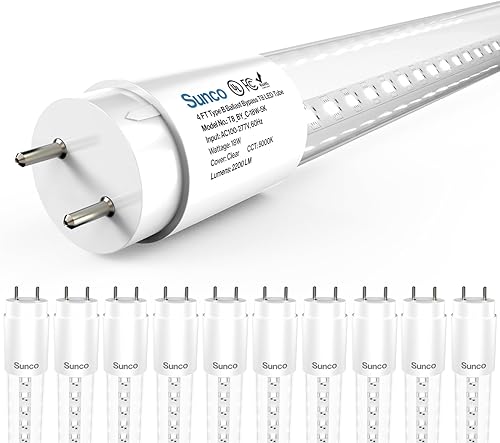 Best for sound existing fixtures
Sunco 10-Pack T8 Ballast Bypass LED Tubes
LED shop lights vs fluorescent: which should you choose?
Choose LED when building or changing your lighting layout. Keep fluorescent lights when they already illuminate the work well and don't need frequent attention.
A new fixture gives you freedom to place light where you need it. A tube retrofit keeps the old housing, including its position and any diffuser or reflector.
That distinction matters more than simply choosing a lamp technology. Converting a poorly placed fluorescent fixture to LED won't move the light out from behind an overhead shelf.
LED vs fluorescent shop lights for different buyers
- New garage or workshop: Choose complete LED fixtures so you can plan rows around benches, vehicles and storage.
- Sound, well-placed fluorescent housings: Consider compatible LED tubes if the conversion work is reasonable.
- Occasionally used storage room: Keep reliable fluorescent lights unless they need repair or leave important areas dim.
- Worn fixtures or damaged sockets: Have the fixture assessed before spending money on replacement tubes.
Buying a new fluorescent fixture is a narrower choice than keeping one you already have. It makes sense when you specifically want that system and accept its lamp and ballast upkeep.
How much electricity can switching to LED save?
Savings depend on total wattage and hours of use, compared at a similar level of useful light. A workshop lit all day has a stronger reason to switch than a storage room used for a few minutes.
The Barrina fixture uses 40 watts for 5500 lumens per light. Each Sunco tube uses 18 watts for 2200 lumens, so a two-tube conversion uses 36 watts for the tubes.
Those outputs aren't direct replacements for each other. A complete fixture and two tubes in an older housing can spread light differently, even when their total lumens are close.
For an existing fluorescent setup, count every lamp and include ballast consumption. Don't compare one LED tube with a whole two-lamp fluorescent fixture.
Calculate energy use by multiplying total watts by hours of use, then dividing by 1000 to get kilowatt-hours. Multiply that result by your electricity rate to estimate running cost.
Include conversion labor and any socket or fixture repairs when weighing the change. Without those costs and your current system's power use, a firm payback claim would be guesswork.
Should you replace the whole fixture or retrofit tubes?
Replace the whole fixture when its condition or position needs to change. Retrofit tubes when the housing, sockets and light distribution are worth keeping.
Barrina for a new layout
The Barrina 10-pack suits a larger garage, a workshop with several work zones or a project needing matching fixtures. It supports plug-in or hardwired installation, with five switched power cords included.
Its V-shaped design has a 270-degree beam angle, which spreads light broadly. Place the fixtures around obstacles rather than expecting a wide beam to reach through shelves or cabinets.
Skip this pack if you only need one bench light or a few replacement tubes. Measure the room and decide how many fixtures you need before choosing a large pack.
Sunco for a compatible tube conversion
The Sunco tubes suit sound fluorescent housings that already sit in useful positions. Their single-sided Type B design requires ballast removal and fixture rewiring before use.
Skip these tubes if you want a simple lamp swap without electrical changes. They are also non-dimmable, so they don't suit a setup that requires dimming.
A ballast-compatible LED tube and a ballast-bypass tube follow different installation rules. Our guide to whether LED shop lights need a ballast explains that choice.
Before buying tubes, use how to replace fluorescent shop lights with LED to plan the conversion.
Which option puts useful light on your work?
Choose for coverage at the work surface, not just a high lumen total. Shelves, vehicle roofs and your own body can block light from a single central row.
Start by marking the areas where you read labels, sort parts or use tools. General room lighting should let you move safely, while detailed work may need a separate task light.
For a broader room plan, see our garage and workshop lighting guide. Use how many shop lights you need for a garage before deciding how many fixtures to order.
The Sunco tube has a 160-degree beam angle. Its orientation and the housing around it affect where the light goes, so follow the installation directions rather than assuming every tube can face either way.
The Lithonia wraparound uses a prismatic diffuser to control brightness and reduce visible lamp images. That design may suit general room lighting, but it doesn't replace a layout that puts light near the work.
Both LED options here use 5000K daylight white. Color temperature describes the light's appearance, while lumens describe output; choosing a higher Kelvin number doesn't automatically give you more light.
If bright lamps fall directly in your normal line of sight, consider fixture position and shielding. Our guide to garage lighting color temperature can help you choose an appearance you'll want to work under.
What should you check before installation?
Plan mounting, power and controls before removing old lights. A fixture that fits the ceiling can still create problems if its cord cannot reach an outlet or its switch is hard to use.
Measure fixture locations and draw the cable route. Keep cords away from garage-door tracks, moving equipment, sharp edges and places where stored items could pull them loose.
The Barrina lights can link up to 6 in one series using the included 48-inch connecting cables. A 10-pack therefore needs more than one series if you use every light.
Check actual cable reach rather than spacing fixtures by eye. If combining older and newer Barrina lights, use the specified new male-female connector cables instead of assuming older connectors match.
Use mounting hardware suited to the ceiling material and fixture instructions. Don't support a light by its power cord or connecting cable.
Decide how you'll switch each work zone. Separate control can let you light a bench without turning on every fixture in the room.
For layout help, follow our LED shop light spacing guide. For connection planning, read how to wire and link LED shop lights safely.
Is a ballast-bypass retrofit a DIY job?
Use a qualified electrician for ballast-bypass work if you aren't trained to do it. Sunco warns that incorrect conversion can damage its tubes and create a fire hazard.
Power must be disconnected at the breaker and verified off with a suitable tester before wiring work begins. A wall switch alone isn't enough to establish that the fixture is safe to work on.
Single-sided tubes require the correct power arrangement and compatible sockets. Matching the tube's length and pin shape doesn't confirm electrical compatibility.
Have the electrician inspect the housing, wiring and sockets before deciding to reuse them. Corrosion, brittle insulation or heat damage can turn an apparent tube upgrade into a fixture replacement.
After a conversion, the fixture should be labeled for its new wiring and required tube type according to the conversion instructions. That helps prevent someone from fitting an unsuitable replacement later.
A plug-in fixture avoids altering the old fluorescent housing. It still needs secure mounting, suitable power and a cord route that stays clear of damage.
When is keeping fluorescent the sensible choice?
Keep fluorescent fixtures that start reliably, cover the room well and remain in good condition. Low use hours and easy access to suitable replacement lamps make keeping them more reasonable.
A storage room used briefly each week has different needs from a workshop used every day. For the storage room, avoiding unnecessary replacement work may matter more than reducing power use.
The Lithonia SB 232 is a two-lamp T8 fluorescent wraparound, with lamps sold separately. Its hinged design allows cleaning, and Lithonia says its instant-on ballast eliminates flickering and humming.
This fixture suits a storage room, office or similar space where its wraparound form fits the plan. Skip it if your main goal is to remove ballast upkeep or move entirely to LED.
Before buying a new fluorescent fixture, account for the lamps as well as mounting and electrical work. Keeping a good fixture and buying a new one are different spending decisions.
If an existing light repeatedly flickers, struggles to start or shows heat damage, have the cause checked. Don't keep buying tubes when the fault may be elsewhere in the fixture.
Do cold weather and room conditions change the choice?
Choose lights approved for the conditions in your garage, especially if it is unheated or damp. An indoor-use light isn't automatically suitable for condensation, leaks or outdoor exposure.
Fluorescent starting and light output can suffer in cold conditions, depending on the lamps and ballast. LEDs can suit cold spaces, but the complete system still needs an appropriate operating temperature range.
Confirm that range before choosing any of these options for an unheated garage. Our guide to LED shop lights in cold weather explains what to check.
Also consider dust and access. A light mounted above a packed storage rack will be harder to clean or replace than one above an open aisle.
For painting or judging finish colors, look for color-rendering information as well as color temperature. The same daylight-white appearance doesn't guarantee that two lights show colors equally well.
What upkeep does each system need?
Keep light surfaces clean and watch for changes in operation. Dirt can reduce useful light, while loose mounts or damaged cords need attention regardless of lamp type.
Turn power off and let the light cool before cleaning. Follow its care instructions, use suitable cleaning materials and keep moisture away from electrical parts.
For fluorescent fixtures, use the correct replacement lamp type and handle tubes carefully. Arrange disposal through an appropriate local collection service because fluorescent lamps contain mercury.
A ballast-bypass LED conversion removes the ballast from future repairs, but the tubes and sockets can still need attention. Replace tubes with the type required by the converted fixture.
With complete LED fixtures, check service instructions before planning repairs. Don't assume you can replace an individual light source as easily as a fluorescent tube.
Keep manuals and conversion labels available. They'll help you identify the right parts without guessing from the shape of the fixture.
Which mistakes make the switch disappointing?
Avoid changing technology without fixing the lighting plan. Better coverage often comes from position and control as much as from the light source.
- Comparing watts as brightness: Use lumens to compare output, then consider how the fixture directs that light.
- Keeping a poor layout: Move or add fixtures where shelves and vehicles cast shadows over work.
- Treating all T8 tubes alike: Confirm the exact tube type, socket requirements and wiring method.
- Ignoring glare: Position bright fixtures outside your usual line of sight at the bench.
- Linking an entire pack automatically: Follow the maximum series length and connection instructions.
- Replacing everything at once: Prioritize frequently used areas or fixtures that already need work.
Don't assume LED will solve every flicker problem, either. Faulty wiring, unsuitable controls or a failing electrical part can require repair before new lights work properly.
Make the switch when it solves a clear problem
For LED shop lights vs fluorescent, choose by the work your room needs next. Replace a failing system, improve a poor layout or reduce long daily running hours.
Pick Barrina when you need several complete fixtures and freedom to arrange them. Pick Sunco when compatible, sound housings deserve reuse and ballast-bypass work fits the project.
Keep reliable fluorescent lights in a lightly used space when they already do the job. Choose the Lithonia fluorescent fixture only when you specifically want a new two-lamp wraparound and accept its upkeep.
Before ordering, sketch the work zones, fixture positions and power routes. Use our guide to choosing LED shop lights for a garage to turn that sketch into a practical plan.
Frequently asked questions
Are LED shop lights better than fluorescent?
LED shop lights are usually the better choice for a new garage or workshop layout. They offer complete-fixture and retrofit options, but the right choice still depends on coverage, wiring and use hours.
Keep sound fluorescent lights if they start reliably, light your work well and need little upkeep.
Can I put LED tubes in a fluorescent shop light?
Only use LED tubes that match the fixture and its wiring arrangement. Sunco's single-sided Type B tubes require ballast removal and rewiring before installation.
They aren't a direct swap into an unchanged fluorescent fixture.
Have a qualified electrician check socket compatibility and complete the conversion if you aren't trained for that work.
Do LED shop lights work in a cold garage?
LED shop lights can suit cold garages, but choose by the manufacturer's operating temperature range. The options here don't guarantee a minimum operating temperature, so confirm that limit before buying.
Check the whole fixture or tube system, since reliable cold starts depend on its electrical parts as well as the light source.
Should I replace fluorescent shop lights that still work?
Keep working fluorescent shop lights when they provide enough light and remain in good condition. Replacement makes more sense during a remodel, after repeated lamp or ballast trouble, or when you need a different layout.
For lights used only briefly, electricity savings alone may not justify a full change.
Which uses less electricity, LED or fluorescent shop lights?
LED shop lights generally use less electricity for comparable useful light, but compare complete systems. Add the wattage of every lamp and include fluorescent ballast use, then account for daily run time.
Installing extra LED fixtures or leaving them on longer can reduce the savings from more efficient light sources.


